Cunonia capensis L. Family: CUNONIACEAE |
||||
|
The genus Cunonia is named after John Christian Cuno who in the 18th Century published a book of verse about his garden in which many exotic plants were growing. The specific name, capensis, means "of the Cape". The Butterspoon tree may be seen in forests and moist areas, especially along watercourses. It is found along the coast and adjacent inland areas from the Western Cape eastwards to Mozambique. In forests it may reach up to 10m in height but where it is growing out in the open it may only reach 5m. We have only one species of Cunonia in South Africa. If you wished to see other Cunonia species in their natural habitat you would have to travel to the Pacific Ocean island of New Caledonia (near Australia), as this is the only other place where members of this genus also occur!
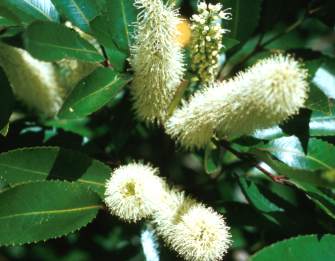
The showy, scented flowers appear from February to May and are carried in dense, creamy spikes which have a bottlebrush-like appearance. The fruits are small, brown, two-horned capsules which release very fine, sticky seed. Seed is dispersed in two ways; firstly by visiting birds which fly off with the seed clinging to their feathers, legs and bills, and then by the wind which blows the fine seed away. It is a beautiful evergreen garden tree which attracts insects to its flowers. It does not grow well in very hot and dry conditions preferring a more temperate climate. Some frost is tolerated so it may be grown on the Highveld in a sheltered spot preferably near water. It is apparently one of the fastest growing of South Africa's forest trees. The Afrikaans common name Rooiels (= Red Alder) is derived from the resemblance of the wood to the true Alders (Alnus spp.) of the Northern Hemisphere.
It may be grown from seed in deep seedtrays filled with seedling mix. The seed is very fine and can be covered very lightly with finely sifted seedling mix. The young plants will need plenty of water and a sheltered aspect. The tree is reportedly used for treating nervous complaints. The wood has been used to make furniture, has a fine grain and is relatively hard and heavy.
Alice Aubrey |
||||
|
To find out if SANBI has seed of this or other SA species, please email our seedroom. This page forms part of the South African National Biodiversity Institute's plant information website www.plantzafrica.com.
|
 One
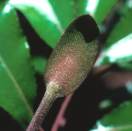
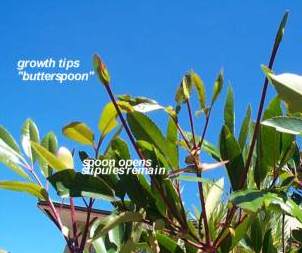
of the most striking characters of the tree is the pair of stipules
which enclose the growth tip. They are large and pressed together
forming a spoon-like shape, hence the name "Butterspoon"
Tree. The leaves are dark green and glossy with contrasting reddish
leaf-stalks.
One
of the most striking characters of the tree is the pair of stipules
which enclose the growth tip. They are large and pressed together
forming a spoon-like shape, hence the name "Butterspoon"
Tree. The leaves are dark green and glossy with contrasting reddish
leaf-stalks.
