|
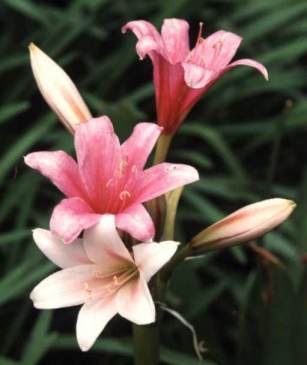
This is a very beautiful lily with funnel-shaped flowers that are
white to pale pink, enhanced by reddish stigmas. Crinum paludosum
is a slender, erect, herbaceous plant that grows in marshy places,
making it a perfect plant for the pond or a swamp.
Description
Crinum paludosum is a low-growing plant that is found in large
colonies in marshy areas. The fully-grown bulb is ± 200 mm
in diameter, but it may take about four years to reach this size.
It is more or less globose, narrowing into a long neck. The leaves
are stem-clasping at the base. The species is characterised by arching
leaves, which are often described by collectors as 'like young maize'.
They are pale green, soft and have wavy margins. Leaves die back
in autumn, but not entirely. A cut-off point is reached from which
the new growth regenerates the following season.
The bushveld vlei lily has a long flower stalk that carries flower
tubes that are ± 120 mm in diameter. The tepals are + 100
x 30 mm and are suberect to spreading. The flowers are white to
pale pink with a darker pink keel. They only open fully at midday
and are slightly sweet-scented. They appear from December to January.
The fruits, that appear thereafter, are about 35 mm in diameter
and are red. This plant usually blooms while submerged in + 300
mm water.
Distribution
The genus is found mainly in tropical Africa; ± 130 species
of Crinum are found all over Africa and 21 in South Africa.
C. paludosum is found growing naturally in large colonies
in marshy places from northern KwaZulu-Natal to Limpopo. It is also
found in Namibia and Botswana.
Derivation of name and historical aspects
The genus Crinum consists mainly of bulbous herbs, the bulbs
of which are relatively large and often contracted into a neck.
They sometimes split to form clumps. The leaves of members of this
genus range from linear, limp and strap-shaped to sword-shaped,
sheathing at the base, arranged in a rosette. Flowers vary in numbers,
colours and shapes.
Crinum is a Greek word meaning 'lily' and paludosum
is a Latin word meaning 'of swamps' or 'of marshes', which is derived
from its preferred habitat.
Ecology
This plant is a food source for amaryllis caterpillars (Brithys
pancratii sometimes regarded as B. crinii subsp. pancratii).
They may be found feeding at the bases of the stems and on bulbs.
These may cause a serious problem on bulbs because the whole plant
eventually rots as a result. They may be controlled by a khakibos
weed (Tagetes minuta) brew that is poured on infected parts.
Dry leaves of the weed may also be used.
Uses and cultural aspects
Most species of Crinum have been recorded as been used medicinally
by Africans. Some species of Crinum are used as blood purifiers.
Roots are ingredients in decoctions used for the treatment of scrofula.
These may be mixed with some other plant species. All members of
the genus are, however, considered capable of causing dermatitis.
The leaves are browsed by stock.
Growing Crinum paludosum
C. paludosum may be grown from seed. Seedlings may take
about four years to flower, as the bulbs take time to reach maturity.
It can also be grown from offsets, should they occur, although they
are not commonly formed from the parent bulb.
Seedlings may be grown in compost-enriched soil. As they mature
they may be taken to a marshy area or a swamp and planted out.
C. paludosum may also be grown in on a shady area with well-aerated
soil and given plenty of water. After flowering, the leaves die
off and the plant goes dormant. During this stage bulbs may be lifted
and stored in a dry place. During the growing season, the bulbs
should not be disturbed as this may have a negative effect on the
flowering of the plant.
C. paludosum is a good companion for summer rainfall, evergreen
Agapanthus species as the flowers and growth form of these
two complement each other, but agapanthus generally require less
water and are not swamp plants.
References
- GERMISHUIZEN, G. & FABIAN, A. 1997. Wild flowers of northern
South Africa. Fernwood Press, Vlaeberg, Cape Town.
- HUTCHINGS, A., SCOTT, A.L., LEWIS, G. & CUNNINGHAM, A. 1996.
Zulu medicinal plants. University of Natal Press, Pietermaritzburg.
- POOLEY, E. 1998. A field guide to wild flowers of KwaZulu-Natal
and the eastern region. Natal Flora Publications Trust, Durban.
Author: Mhlonishwa D. Dlamini
Witwatersrand National Botanical Garden
April 2003
|