|
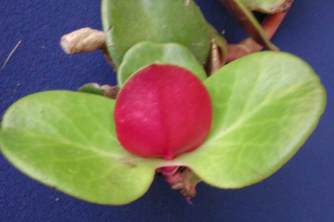
This forest jewel with deep green and red leaves grows in the deep
shade of the coastal forest growing the sandstone cliffs of the
Pondoland river gorges. Although rare at present, it propagates
easily and would make an interesting indoor plant.
Description
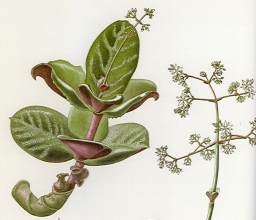 At
first this plant was thought to be a form of Crassula multicava,
but in fact differs from it in several ways, the main one being
that the guttation glands which form pits on the leaf surfaces only
occur along the margins of the leaves in Crassula streyi
and are not scattered on the surfaces. The broadly elliptic succulent
leaves are dark glossy green on the top, while the under surface
is maroon to carmine giving it a striking appearance. Some forms
have attractive white spots along the veins on the upper surface
of the leaf. The leaves become longer as they age. At
first this plant was thought to be a form of Crassula multicava,
but in fact differs from it in several ways, the main one being
that the guttation glands which form pits on the leaf surfaces only
occur along the margins of the leaves in Crassula streyi
and are not scattered on the surfaces. The broadly elliptic succulent
leaves are dark glossy green on the top, while the under surface
is maroon to carmine giving it a striking appearance. Some forms
have attractive white spots along the veins on the upper surface
of the leaf. The leaves become longer as they age.
It is a relatively slow growing perennial to 350 mm tall, but is
usually shorter as the stems tend to sprawl and lose the lower leaves
as get older. The lax stems sometimes send down roots.
The dainty terminal sprays of greenish yellow flowers are tinged
red and borne in May and June.
Distribution
C.streyi occurs from Oribi Gorge in Kwa Zulu/Natal to Mkambati
Reserve in Pondoland. Both these reserves are on or near the coast.
It always grows in shade, usually on cliff faces in the subtropical
forests of the area. It is found in the moist, humus-rich pockets
of soil on the sandstone and occasionally in the leaf litter that
collects on the forest floor.
Derivation of name and historical aspects
It was first collected by Mr. R.G. Strey of the National Botanical
Research Institute in Durban and was named in his honour. The name
Crassula is derived from the Latin "crassus" meaning
thick and refers to the leaves. The genus Crassula occurs
mainly in S. Africa and is a large one with over 300 species. About
150 species are found here, with others found in Europe, America,
Australia and further afield.. A very similar plant is C. multicava,
a popular garden plant much used as a ground cover.
Ecology
Because this plant is known only from a few localities, not much
is known about it. It is thought that the bright red under side
of the leaf enhances the collection of light in the deep shade of
the forest floor..
Uses and cultural aspects
There are no records of this plant being used or grown.
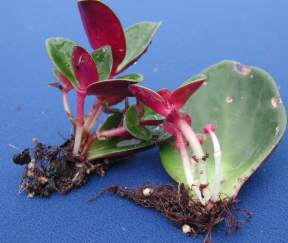
Growing Crassula streyi
 Because
the plant can tolerate very low light conditions and has such attractive
contrasting leaf colours, it would be very suitable for indoor pot
plant culture. It could possibly also be used as a ground cover
in shady positions or in a very shady pocket in a rockery, but it
is not as fast growing or robust as Crassula multicava. It
is drought resistant too. Because
the plant can tolerate very low light conditions and has such attractive
contrasting leaf colours, it would be very suitable for indoor pot
plant culture. It could possibly also be used as a ground cover
in shady positions or in a very shady pocket in a rockery, but it
is not as fast growing or robust as Crassula multicava. It
is drought resistant too.
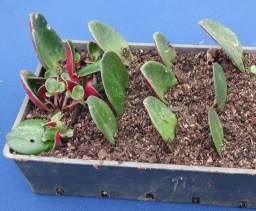
The plant is best propagated from stem or leaf cuttings in trays
containing a mixture of equal parts fine milled bark and coarse
perlite. The leaves or cuttings should be allowed to dry out for
one or two days before inserting them in the mixture. Planted trays
should be kept on the dry side in very shaded conditions until the
new stems appear after which they can be potted on into bags or
pots containing a loose well drained mixture and kept in deep shade.
Hollman 1997 observed that rooting takes place best at the nodes
in stem cuttings.
References
- WILLIS, J.C. 1966. A Dictionary of the Flowering plants
and Ferns, Cambridge: Cambridge University Press
- VAN WYK, A. E. & SMITH, G. 2001.Regions of Floristic
Endemism in South Africa. South Africa; Umdaus Press.
- TÕLKEN, R. R. 1973; The flowering plants of Africa;
Vol 42 parts 3 and 4; South Africa; Botanical Research Institute.
- SCOTT-SHAW, R. 1999. Rare and Threatened Plants of KwaZulu-Natal
and Neighbouring Regions; Pietermaritzburg. KwaZulu-Natal
Conservation Service.
- HOLLMAN, J, 1997. The propagation of Crassula streyi. Plantlife
17:33
|
|
B.B.Tarr & Siyabulela Nonjinge
KwaZulu-Natal National Botanical Garden
February 2004 |
|

