Crassula coccinea L. Family: Crassulaceae |
||||
|
Hiking up Table Mountain in midsummer to find the red disa Disa uniflora in flower, one is sure to see the brilliant red Crassula coccinea hanging from the cliffs. If lucky, and patient, one will also see the mountain pride butterfly Meneris tulbaghia, which pollinates both. This large butterfly with chocolate brown wings has the unique behavior of being drawn to the colour red. With its long proboscis or tongue, the mountain pride butterfly is able to reach for nectar in the narrow flowers of Crassula coccinea and other species with large red flowers such as the cluster disa Disa ferruginea, the Guernsey lily Nerine sarniensis and the iris Tritoniopsis triticea.
Growing Crassula coccinea Crassula coccinea are easy to grow and flower in the garden where they look good in a rockery, pots or planted in a bed. This is an excellent waterwise plant that needs full sun and good drainage. The plants grow fast and can flower in their first year. They get untidy after a few years and are best replaced after about 3 years. Plants are subject to rust, but sensitive to fungal sprays.
There are about 200 species of Crassula found predominantly in the southern hemisphere and mainly southern Africa.
Ernst van Jaarsveld & Liesl van der Walt |
||||
| To find out if SANBI has seed of this or other SA species, please email our seedroom. This page forms part of the South African National Biodiversity Institute's plant information website www.plantzafrica.com.
|
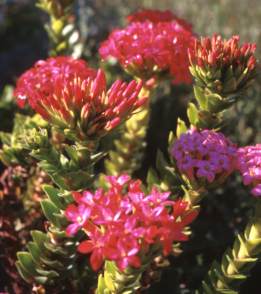
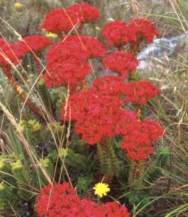 Crassula
coccinea occurs naturally in the Western Cape where it grows
on the quartzitic sandstone mountains on bare rocks or shrubby slopes
usually at altitudes of 800 metre and higher. A small succulent
shrublet about 400mm high, it has a few stems that branch from the
base. As the plants get older the bottom of the stems turn brown
and dry with the bright, new leaves at the ends. The succulent leaves
are flat, oval shaped and arranged to overlapping each other along
the stems. In midsummer (January - March) the striking flowers are
formed in a dense flat-topped head at the tip of the stems. The
long tubular flowers are fragrant and brilliant red, especially
in sunshine.
Crassula
coccinea occurs naturally in the Western Cape where it grows
on the quartzitic sandstone mountains on bare rocks or shrubby slopes
usually at altitudes of 800 metre and higher. A small succulent
shrublet about 400mm high, it has a few stems that branch from the
base. As the plants get older the bottom of the stems turn brown
and dry with the bright, new leaves at the ends. The succulent leaves
are flat, oval shaped and arranged to overlapping each other along
the stems. In midsummer (January - March) the striking flowers are
formed in a dense flat-topped head at the tip of the stems. The
long tubular flowers are fragrant and brilliant red, especially
in sunshine. 


